Of all challenges a non-italian may face when discovering the italian culture and cuisine, the two biggest probably are: cooking al dente pasta and preparing a true, authentic, italian coffee (known as espresso abroad).
.
.
.
.
How to prepare a coffee with the traditional coffee maker:
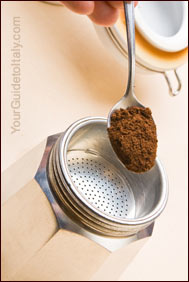
Remove the filter (D) and pour water in chamber A up to the small metal button you see inside. Put the filter back in place and fill with ground coffee. Press the coffee slightly (do not press too hard, otherwise the waterdamp will not pass through the coffee ground). Screw the collecting chamber (C) back on and put the coffee maker on the stove.
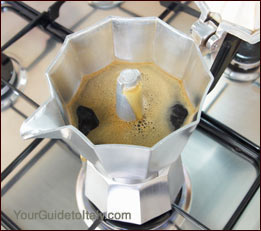
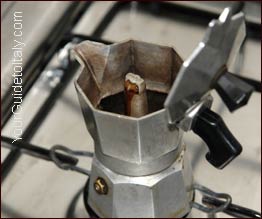
Do not leave the espresso pot heating for too long. You will hear the coffee bubbling out of the chimney inside the collecting chamber and this characteristic sound will change when the last drops are coming out.
The coffee has a burnt taste:
Either the espresso pot remained too long on the stove after the coffee was ready, or the coffee ground itself was roasted too dark. If the latter is the case, try medium-roasted coffee, which is best to make an Italian espresso.
The coffee is too strong:
Use less coffee.
The coffee looks ready (no more coffee is coming out of the chimney), but it is very strong and there is still water in the bottom of the chamber.
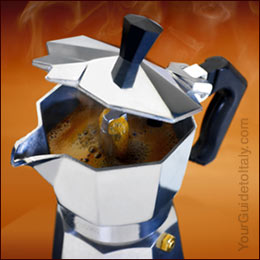
Basically, there are two ways to make an italian coffee, either with the traditional three-chambered aluminium pot, like the famous Bialetti's Moka Express, known as Macchinetta or caffettiera, or with an espresso machine.
In both cases, though, quality is of the utmost importance. No counterfeited products here! The same goes, of course, for the quality of the coffee. Only choose italian brands that have been roasted and ground especially for espresso machines or mokka makers.
Traditional aluminium coffee maker
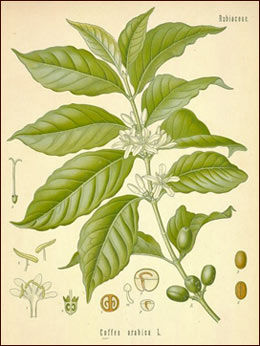
Coffea Arabica
Source: Köhler's Medizinal-Pflanzen in naturgetreuen Abbildungen mit kurz erläuterndem Texte,
Franz Eugen Köhler, 1887.
However, Italians themselves claim that the quality of their coffee ultimately depends on the purity of the water. So, unless you live in Naples (the Italian city where supposedly they make the best espresso), we suggest you use bottled instead of tap water.
Even though the investment is much higher in case you decide to opt for an espresso machine, it is also relatively easier to select one that will make you good espressos. Just compare the technical details and specifications sheets of your pre-selected machines with the details provided in our article and you should be able to make the right choice. Read more about how to chose a good espresso machine.
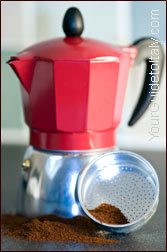
Italian style coffee maker
Paradoxally, it may be more difficult to find a good traditional coffee maker. Here is our first tip: buy a good brand right from the start (not necessarily the most expensive one!). The brand of coffee is, of course, also crucial to making a good espresso. Some of the brands that you can easily find abroad and that we can recommend, are Caffe Kimbo Espresso Napoletano, Illy medium-roast (fine grind), Lavazza Crema e Gusto and Illy medium-roast decaffeinated.
Also, you may have to change your Moka coffee pot a couple of times before you finally find the one that makes the kind of coffee you like. Our second tip is to take great care of your coffee maker and to replace the filter (D) and the rubber ring (E) as often as needed. Never, ever clean your coffee maker with detergents or harsh chemicals. Just rince it with care after each use.
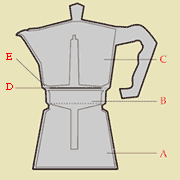
Mokka Coffee Pot
A: Bottom chamber which contains water. When the pot is heated on a stove, pressure from the steam pushes the water through B (Basket containing ground coffee) and into C (Collecting chamber for coffee)
D: Filter
E: Rubber ring that keeps the filter in place
YourGuidetoItaly.com 2005-2013 © All Rights Reserved.
Photos of the YourGuidetoItaly.com banner (from left to right): red boat landscape © mmac72/Istockphoto; Wine © RCphotografia/Istockphoto; Vitruvian man © Jodie Coston; Italian food © photovideostock/Istockphoto; Fiat 500 by
tizianoj,
How to make a real italian coffee ?
(How to use an Italian Mokka Coffee Pot)
You can also check by lifting the lid of the espresso pot, when the drops are coming out more slowly the coffee is ready. Once the coffee is ready remove the espresso pot immediately from the stove, otherwise the coffee will get a burnt taste.
This means either that you pressed the coffee too much, or that you put too much coffee in the filter. In that case the waterdamp will not be able to percolate through the coffee ground. Use less coffee and press it a little less.
Another (very common) reason is that after a while the filters may become obstructed. Remove the rubber ring and the filter under it and clean both filters thoroughly with water.
Some solutions to common problems:
Photo credits (from top to bottom): traditional coffee maker © fotomantello/Fotolia.com; red top coffee maker © Dale Mitchell; filling filter with coffee © raphotography/Fotolia.com; coffee maker on stove © Alex Hubenov/Fotolia.com.
Espresso Making Perfection:
How To Make The Perfect Espresso
Espresso Coffee,
Second Edition:
The Science of Quality
by Rinantonio Viani, Andrea Illy (Editors)
More information: